A Visitor's Guide to The Art Institute of Chicago
by Jeffrey Sachs, Freelance Writer

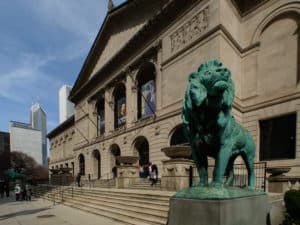
Exterior picture of The Art Institute of Chicago


This attraction is included in the Go Chicago Card
Go Chicago Card
Includes this attraction

Purchase & Save $


HISTORY

The Art Institute was originally founded as the Chicago Academy of Fine Arts in 1879 amidst the rubble of the Chicago fire of 1871. As the city braced itself to host the 1893 World's Columbian Exposition, it was evident that a larger structure was needed, establishing the current location at Michigan and Adams. Though the Art Institute started modestly enough as a display of plaster casts, through acquisitions and donations the present state of the Art Institute is nothing short of one of the most remarkable collections in the world.

Let us begin our journey through the Art Institute of Chicago. The collection, which houses over 4,500 paintings, is staggered over three levels (Lower, First and Second) and has art from over 50 countries on 6 continents. I’ll be touching on only some of the most important periods, but there is far more to see and do than just what I will impart. Before you begin your tour you may want to think about using one of the three Art Institute’s Audio Guides.

AUDIO GUIDE

Here’s how it works: You rent a pair of headphones and an audio device (which looks like a cellular phone). Each room is numbered, so when you enter a room, you will enter the room number into the device and the audio narrator will give a brief description about the period and point out the significant pieces. If you are more inclined to learn than just look, my advice is to take the audio tour. Since it is self-guided, you control the pace, and the in-depth info that is provided will be vital to your enjoyment. And at $6 per person it is completely worth the extra cost.

See more details about the three audio guide tours.

BUILDING LAYOUT


FIRST LEVEL

Asian

The Asian galleries contain over 35,000 pieces from China, Korea, Japan, India and Southeast Asia. Here you’ll find the oldest pieces in the Art Institute, dating back over 5,000 years. Some of the earliest specimens of painted ceramics, textiles and sculptures are housed in this homage to art’s first families. Asian art has been able to transcend generations because the artists believed that each person, regardless of wealth, should be exposed to art in everyday life. Without those types of philanthropic ideals, the world would be a different place.

WHAT TO LOOK FOR:

  • Ceramic vases, jars and bowls from the Ming Dynasty.
  • Assortment of Japanese woodblock prints .

JAPANESE

MING
 

Contemporary

“Contemporary” means that art is not associated with any particular past movement or school of thought. Emerging in the early 1960’s after the fall of the Modern Art movement, Contemporary Art generally has its focus on political, social or economical themes. Other defining characteristics of Contemporary Art are the materials that are used. Of the nearly 1,000 examples of Contemporary art, you will see photos, videos and large-scale installation pieces as artists exploit the medium to convey their message.

There are no limits to the creativity or style of Contemporary Art, resulting in pieces that are bizarre, but also beautiful. What truly makes Contemporary Art so popular is that every piece is open to your own interpretation;  there are no wrong answers here.

WHAT TO LOOK FOR:

  • Jackson Pollack’s “The Key”
  • Andy Warhol’s celebrity silk screens
  • Eva Hesse’s “Hang Up”

POLLACK

WARHOL
 

Other notable exhibits on the First Level:

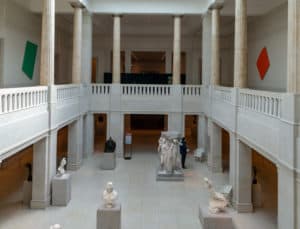
McCormick Sculpture Court - With natural light raining down from above, these gleaming white marble statues will beckon you to stop and stare.

Suit of Arms Collections – See the intricate designs on emblazoned armor that shielded men from the ravages of battle

Icons of Divinity – Stone and metal comprise these various representations of South and Southeast Asian divine deities.


SECOND LEVEL

Modern

Beginning with the rise of the Industrial Revolution in the late 19th century, artists began experimenting with the foundations of art, using new techniques and styles. Several new forms of art appeared, as artists used their craft to express these periods of unrest. While we generally point to Dali and Van Gogh as the ones who defined Modern Art with their Cubist and Surrealist movements, Modern Art’s true origins live in the Parisian-born movement dubbed Impressionism.

Modern art will no doubt challenge you to make sense of images you could never dream possible. Juxtaposed scenes and invented realities from the subconscious mind divide Modern art from the rest.

WHAT TO LOOK FOR:

  • Salvador Dali’s “Visions of Eternity”
  • Rene Magritte’s “Time Transfixed”
  • Vincent Van Gogh’s “Self Portrait”

DALI

MAGRITTE

VAN GOGH

European Painting and Sculpture

Tucked into this broad category is the movement known as Impressionism, which takes place from 1867-1886 and includes the likes of Monet, Manet and Degas. Impressionism’s daring jump from the ordinary spurned traditional, religious and political subjects and focused on the everyday lives of everyday people. Everything about the movement went against convention, with three apparent deviations from classic art at the time:

  • Light, pastel colors were used instead of richer, darker shades.
  • Regular people in natural settings were now used in place of religious icons or people of stature.
  • Paint seemed to be applied quickly using hurried strokes, instead of meticulously and evenly for a cleaner look.

While Impressionism initially broke the rules, its popularity grew and garnered its own place on the walls of art galleries, thereby inspiring future movements. The exhibit at the Art Institute contains some the most famous painters and some of the most recognizable paintings.

WHAT TO LOOK FOR:

  • Claude Monet’s “Haystack” variations
  • Marc Chagall's "White Crucifixion"

MONET

CHAGALL

TIP: The second level is split into two parts, separating Impressionism from American Art. You have to use the stairs or elevator to go down one level and then back up. If you have trouble navigating, consult your map or museum personnel for help.

American

While American Art has roots tracing back to the early 1800’s with Native American paintings by Frederick Remington, it wasn’t until the early 20th century that solidified America’s place in the art world. Taking a cue from Impressionism, Americans created a rapidly sweeping movement called Regionalism. Art of this period typically depicted hard-working Americans trying to free themselves from of the grip of the Great Depression. American artist’s sought to illustrate the positive side of the working-class American family in an effort to instill hope for a brighter future. Grant Wood’s “American Gothic” is perhaps the most famous of these Regionalist works.

Other artists like Georgia O’Keeffe, who honed her craft right here at the Art Institute of Chicago during 1905-06, instead sought to find art in the uncharted territory of the western United States. At the Art Institute you’ll find extraordinary examples of her ability to find symmetry and beauty amid the harsh desert settings of New Mexico.

American artists produced some of the most famous paintings that we know and are here in all their glory.

WHAT TO LOOK FOR:

  • Georgia O’Keeffe’s Southwest inspired motifs
  • Grant Wood’s “American Gothic”

O'KEEFE

WOOD

LOWER LEVEL

Kraft Education Center

The activities at the Kraft Education Center and the “Faces, Places & Inner Spaces” exhibit strive to encourage independent thought, whether it be as artist, subject or critic. There are different stations that focus on various aspects of art. One station will have you dress up as a Kabuki theater performer, another will have you analyze different features of a painting, and still another will teach you to draw using a grid technique. Each station promotes discussion and helps children understand art. This is one of the most thoroughly interactive and thought-provoking exhibits you can find.

TIP: Be sure to bring extra paper and pencils. The Family Room, located in the Kraft Education Center, is a great place to take a break and read one of the hundreds of books on hand, or to practice drawing.

Thorne Miniature Rooms

The Thorne Miniature Rooms exhibit is home to the world’s largest collection of miniature rooms in the world, containing 68 individual rooms. All are completed in 1/12 scale and capture the most influential architectural designs of the past four centuries. Some of the rooms on display:

  • Replicas of 18th and 19th century Colonial American homes.
  • Modern Japanese and Chinese homes.
  • Versions of English Drawing Rooms, spanning 250 years.

Be sure to look side to side and up and down, because there is more than meets the eye at first glance.

Other notable spots on the Lower Level:

Touch Gallery
The Touch Gallery provides a “hands-on” experience when it comes to art. Originally designed for visitors with limited sight, the gallery provides an opportunity to feel the detail and texture in these marble and bronze works.

The Café:
The Café is quick and easy, serving up burgers, pizza, salad and sandwiches. Should you desire a more formal dining experience go to The Garden Restaurant, which features seasonal cuisine, a full bar and wine list.

UPCOMING EXHIBITS

Douglas Garofalo – June 17–October 8, 2006 – The Chicago-based architect behind the “Faces, Places & Inner Spaces” exhibit in the Kraft Education Center is getting a temporary home at the Art Institute to showcase his various designs.
Stories from the Silk Road – August 26, 2006–May 28, 2007 – Find out why the trade routes that connected Asia with Europe still have an important place in history. To learn more visit www.silkroadchicago.org  and find out about all the activities during this year-long celebration.


CONCLUSION

As visitors we are presented with the opportunity to delve in the artist’s mind, interpret his or her intent and uncover the meaning of the work. But after you leave, whether you remember the artists by name, like Jackson, Vincent, or Pablo, or whether you remember that “funny looking seat”, the Art Institute has done its job to keep art alive and inspire the next generation.

TIP: DO’s and DON'Ts

DO stop by the The Museum Shop. They have prints and posters of the most famous paintings. I can’t think of a more practical souvenir.
DON’T wait to visit on Thursday nights, when it’s free. The heavier crowds may limit your enjoyment.
DO keep the Art Institute in mind if there is cold or rainy weather in the forecast.
DO print off one of the monthly Self Guided Tours.
DO bring pens and paper in case you feel the need to create some art of your own.
DO take breaks during the day…Drawing breaks, planning breaks, eating breaks.
DO take pictures. DON'T use a flash.
DO consider taking public transportation. Parking is available at several locations but will cost anywhere between $13 and $21.
DO print the museum layout before you go to plan your visit. Floor Plans: First Level, Second Level, Lower Level.
DO sign-up for the Museum Newsletter for periodic updates.

WEB LINKS

This attraction is included in the Go Chicago Card

Note: The Go Chicago Card includes this attraction
Purchase & Save $


Featured: Chicago Video Collection
Top Chicago Attractions | Downtown Hotels Map | Suburban Hotels Map | Hot Things-To-Do
VISITOR GUIDES:
Navy Pier | Museum of Science | Theatre  | Shedd Aquarium | Chicago Tours